

The Caribbean Hotel and Tourism Association (CHTA) teamed up with travel intelligence specialist ForwardKeys to produce an in-depth study of air traffic and the tourism prospects for the region.
“A data-based approach to destination promotion and management will be foundational for a sustainable, resilient and profitable future for the region’s tourism sector,” commented CHTA President Nicola Madden-Greig, about the study.
Here TMI presents some of the most relevant highlights.

Travel trends: Caribbean tourism robust, but growth is slowing
International arrivals to the Caribbean were up +10% year on-year in the first half of 2024 – and overall growth increased +13% compared to 2019. Forward Keys notes that tickets for international arrivals globally are still 16% below pre-pandemic levels, underlining that the Caribbean remains a strong performer.
Nevertheless, the year-on-year growth, while positive, represents a more modest increase compared to the rest of the Americas, which are up by +15% over the same period. This means that Caribbean destinations will need to develop strategies to remain relevant in an increasingly competitive travel environment, especially as Asia completes its recovery and competes for market share, says the report.
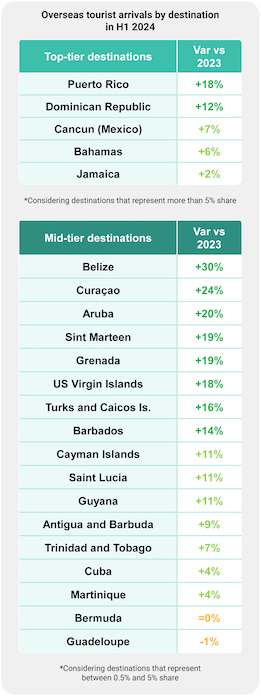
Several top-tier Caribbean destinations— those representing a market share of 5% or larger — are leading the way. Puerto Rico tops this ranking, with overseas arrivals +18% year-on-year in the first half of 2024, driven primarily by arrivals from the United States. Specific U.S. markets showing strong growth include Atlanta (+54%), Houston (+23%) and Fort Lauderdale (+20%).
The Dominican Republic (+12%) is also showing significant growth, boosted by increased connectivity from key origin cities such as Orlando.
Cancun in the Mexican Caribbean (+7%), the Bahamas (+6%) and Jamaica (+2%) are also growing, although more moderately.
Mid-tier Caribbean destinations – those with a market share between 0.5% and 5% — also showed impressive growth in the first half of 2024, reports ForwardKeys.
Belize leads the list with international arrivals up +30% year-on-year. Bookings from New York alone are +91% higher than in 2023 following the launch of new direct flights in December. Overall, the top-performing mid-tier destinations are expected to reach double-digit YOY growth. Only Bermuda and Guadeloupe are at or behind 2023 levels, says ForwardKeys.
.
Business travel lags behind leisure, but starting to improve
While the Caribbean’s post-pandemic travel recovery is being driven by leisure visitors, business travel is showing just 3% growth over the same period. This highlights the slower recovery of this segment as virtual meetings remain prevalent post-pandemic.
However, there is encouraging growth at a destination level, with the Dominican Republic (+14%), the U.S. Virgin Islands (+29%) and the Cayman Islands (+23%) all showing substantial increases in overseas business travel arrivals.
.
Premium class travel gains
Bookings in high-end cabins – First and Business class – are substantially outperforming the market average, reports Forward Keys, showing growth of 39% compared to the same period in 2023.
This indicates the “enduring strength” of luxury travel to the region, says the report. The Turks & Caicos Islands (+73%), the Cayman Islands (+68%), and the U.S. Virgin Islands are showing the highest growth in high-end travel, and collectively account for almost 10% of all premium arrivals.
This trend bodes very well for luxury travel retail and duty free sales in the region.

Intra-Caribbean connectivity & multi-destination trips
Connectivity (air capacity) to the Caribbean is showing impressive growth, increasing +13% overall in the first half of 2024 compared to the previous year. Canada is contributing significantly to this success with an increase in seat capacity of +17%, which makes it the largest origin market currently performing above the global average. The U.S., which is the largest origin market overall, is tracking global average growth at 13%.
However, intra-Caribbean connectivity expanded by 20% year-on-year.
This is a critical element to enable multi-destination trips within the region. The most notable increases were from Cancun (+78%), Barbados (+56%) and the U.S. Virgin Islands (+50%).
Connectivity from Latin America delivered a more moderate increase, with 6% growth in capacity over the same period. However, at the country level there is significant growth in key markets. Brazil is the standout origin market with seats to the Caribbean up an impressive +112%, followed by Argentina at +83%.
Growth in connectivity from Europe is slower at +2%, but a number of origin markets are performing above average, especially Germany (+11%), the UK (+6%) and the Netherlands (+5%) — a promising sign for Caribbean destinations as these markets are traditionally associated with higher than average spend.
Intra-regional connectivity is crucial as the Caribbean seeks to attract more multi-destination travelers looking to explore the diversity of the region’s tourism offer.
.
Connectivity: North America
Toronto is the top-performing North American origin city for travel to the Caribbean in the first half of 2024, with arrivals up 23% year-on-year. This growth was supported by a 15% increase in seat capacity between Toronto and the Caribbean, with various airlines increasing the number of available flights.
In the United States, New York (+13%) also shows sustained growth, as well as key origin markets Dallas (+21%), Orlando (+18%), Charlotte (+18%) and Washington D.C. (+18%), more indications of the ongoing strength of U.S. demand for Caribbean destinations, says ForwardKeys.
Direct flights between North America and the Caribbean have improved significantly since 2019. In the first six months of 2024, 68% of all arrivals from the U.S. and Canada are flying directly to their Caribbean destination, an increase of 5 percentage points compared to pre-pandemic levels, says the report.
Despite this growth in direct service, a substantial 32% of arrivals will still connect via at least one hub, notes ForwardKeys.
Charlotte Douglas International Airport is the top performing North American hub for Caribbean connectivity, with passenger numbers up by 23% year-on-year in the first half of 2024. Other major hubs such as Dallas, Miami and Atlanta are also becoming increasingly important for connecting the Caribbean to U.S. markets, also offering expanded direct capacity to the region.
From Charlotte specifically, airlines have added 30% more seats to Caribbean destinations in the first six months of 2024 compared to the equivalent period in 2023.
Connectivity: Latin America surpasses 2029 levels
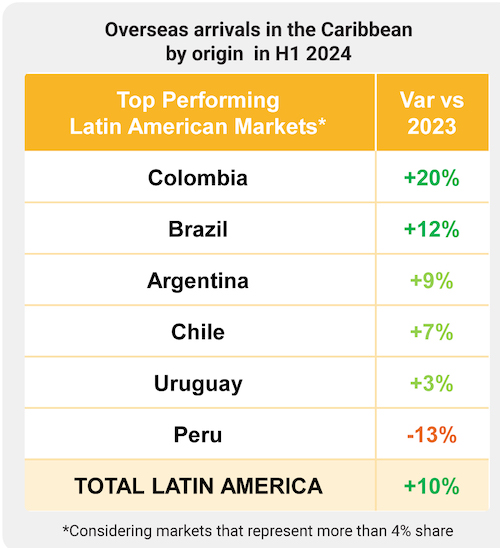
Latin America is becoming a key emerging source market for the Caribbean, with arrivals in the first half of 2024 increasing by 17% above 2019 levels, and 10% above 2023. Importantly, high-yield travelers (up by +13%) are showing better growth than economy class travelers (up by 10%), which offers a positive opportunity for destination spending, says ForwardKeys.
At the country level, Ecuador and Colombia are the top performing origin markets, each increasing by 20% more arrivals year-on-year. Ecuadorian travelers are driving growth to Aruba (+136%) and Curaçao (+70%); Colombian visitors are a main factor in Cuba’s recovery, with arrivals soaring by +221%, according to ForwardKeys.
Business travel from Latin America to the Caribbean is also recovering to a degree, although at a slower pace than leisure travel. Key markets for international business travel from Latin America include Colombia (+46%), Uruguay (+35%), and Mexico (+20%, excluding Cancun). Curaçao (+26%) is the most popular destination for business travelers from Latin America.
Connectivity: Europeans looking elsewhere, but high-value travel grows
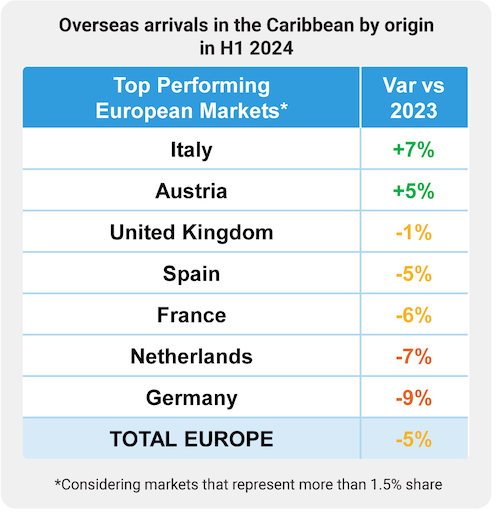
Overall European arrivals to the Caribbean are 5% lower in the first half of 2024 compared to the previous year. However, European travel to other long-haul destinations is showing strong growth. Asia Pacific is the highest performer year-on-year, with arrivals up 37%, driven by the reopening of major destinations such as China (+182%), Vietnam (+50%), Japan (+48%) and Thailand (+47%).
Travel to the Americas (excluding the Caribbean) is also 9% ahead of last year, led by above-average growth to Peru (+44%), Chile (+14%), Colombia (+13%), and Brazil (+10%) — which ForwardKeys says is suggesting that European travelers who took advantage of less restricted travel to the Caribbean in recent years are turning their attention elsewhere as new opportunities open up.
However, despite the weaker overall European performance, high-yield travelers from Europe to the Caribbean are up by+5%, particularly from the UK (+19%), indicating that the region remains an attractive option for the luxury market