
Leading travel retail research agency m1nd-set has released a comprehensive ten-year retrospective analysis tracking the health and evolution of the global travel retail industry. Using its Business Intelligence Service (BIS) database*1, the research reveals that today’s traveler is fundamentally different from 2016, transitioning from a focus on value and promotions to greater self-purchase intent and appetites for discovery and exclusivity.
(* The B1S global database has been continuously tracking and analyzing travel retail shopper behavior across all categories, as well as across multiple segments and time periods, since 2016.)
m1nd-set says that the analysis looks at how traveler habits have evolved from 2016, before, through and after the global Covid-19 pandemic, and up to the first half of this year. Among the key findings of this ten-year analysis is the changing pattern of store footfall and purchase conversion.
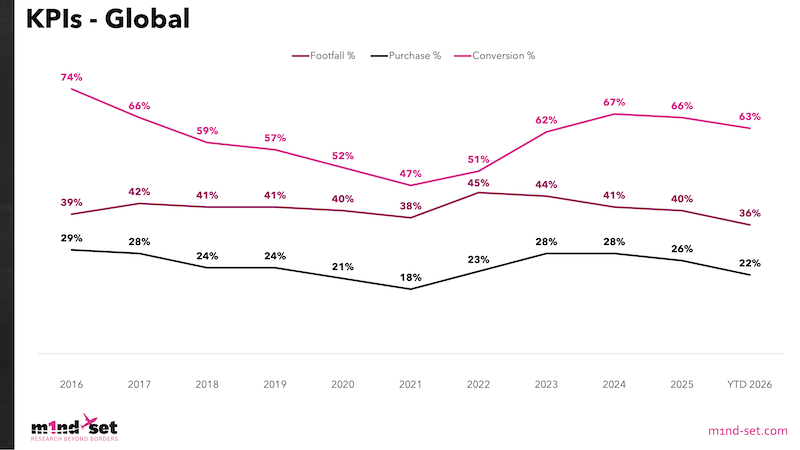
Globally, duty free footfall has declined since the Covid-19 pandemic. While four in ten international travelers visited shops before the pandemic, that figure fell to 36% in the first half of 2026.
The global purchase rate followed a similar trend, declining from 29% in 2016 to 18% in 2021, and recovering to 22% in 2026. However, conversion has remained resilient. In 2016, conversion stood at 74%. After hitting a low of 47% in 2021, conversion stabilized at 63% in the first half of 2026, showing, according to m1nd-set, that those who enter the shops are highly motivated buyers.
The research reveals a marked convergence trend of shopper behavior across world regions and age-groups. Pre-pandemic footfall was strongest in Asia Pacific, peaking at 50% between 2017 and 2019, while the Americas recorded the lowest at 32% in 2016.
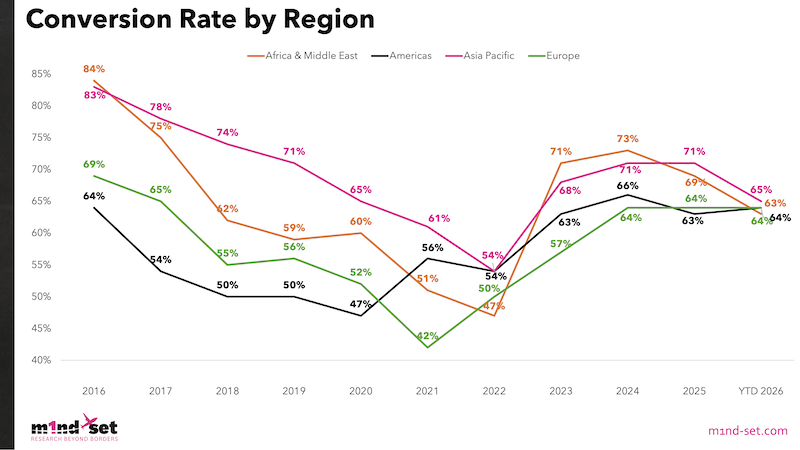
By 2026, regional footfall converged to between 34% and 36%. Similarly, regional conversion rates have aligned, with all regions standing uniform between 63% and 65%.
Generationally, age-based footfall differences have disappeared, with Boomers settling at 36%, Millennials and Gen X at 35%, and Gen Z at 34%. This is a major shift from pre-2020, when Millennials and Gen Z dominated footfall with visit rates above 45%. Conversion rates across all four age segments have also aligned to between 63% and 65% in 2026, according to the research.
Commenting on the findings, Dr. Peter Mohn, CEO & Owner at m1nd-set, highlighted the strategic actions stakeholders must take to navigate this evolving landscape: “While post-pandemic shoppers visit duty free stores less often, they enter with clearer intent. With conversion rates high but footfall down over the past 5 years, the primary challenge is no longer converting visitors but giving travelers a compelling reason to step through the door in the first place. Stakeholders must focus on enticing travelers before they reach the airport or store,” Mohn said.
The most decisive behavioral shift over the past decade is in purchase purpose. Travelers are increasingly shopping for themselves, with the global share of self-purchases rising from the mid-40s in 2016 to 59% in 2026. In contrast, gift purchases have fallen quite significantly from circa 40% to just 18% by 2026.
This personal focus is closely linked to an appetite for discovery and exclusives, according to m1ndset. After reaching 69% in 2022, up from the mid-to-high 50s range before the pandemic, first-time buyers represent 64% of duty free shoppers in 2026. Demand for travel retail exclusives (TREX) rebounded powerfully from a 2020 pandemic low of 31% to 66% in 2026. Gen X and Boomers have steadily increased TREX purchases, now converging with younger age-segments at 65% to 66% in 2026.
Purchase planning has also evolved. Specific pre-planning, where shoppers know their desired brand beforehand, has grown from 21% in 2016 to 30% in 2026. In contrast, partially planned purchases declined from 59% to 44%, and pure impulse purchases fell to 26%. This means the vast majority still arrive with partial or open intent, giving retailers a prime opportunity to influence final brand choices on the shop floor.
According to m1nd-set, given that still a significant share (70%) of purchases involves either partial planning or impulse purchases, travel retail stakeholders have a major window of opportunity to influence brand choice on the shop floor.
“Retailers need to capture partial planners early via pre-trip digital messaging and airport-terminal advertising. Clear value and exclusivity messaging in pre-travel touchpoints, combined with high-impact store entrance displays, will effectively entice passing travelers inside,” comments Mohn.
“While younger travelers initially led in footfall and conversion, generational performance has converged over the past decade. Over-focusing on a single age segment risks alienating equal-value shoppers. It is vital to align age-specific marketing proportionally with each segment’s traveler share.
While this means a growing focus on younger age segments, Gen X and Boomers still require attention. Campaigns must communicate value and exclusivity across all age groups” Mohn concluded.
Companies interested in acquiring either the full research or regional, generational or other segment specific data, can contact m1nd-set at info@m1nd-set.com.