
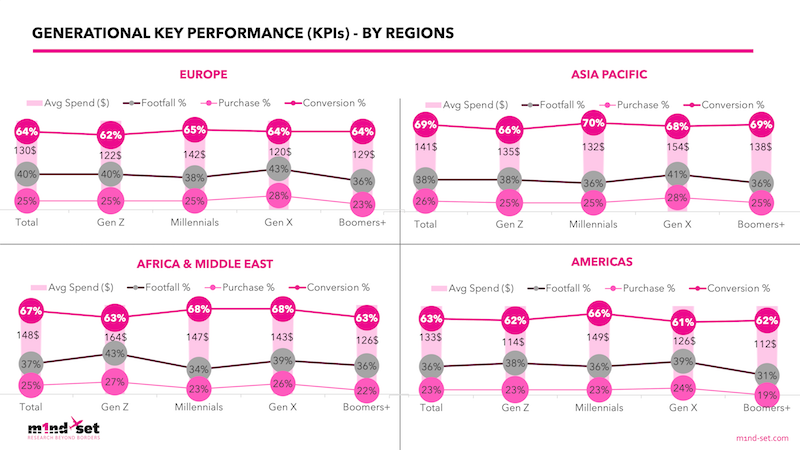
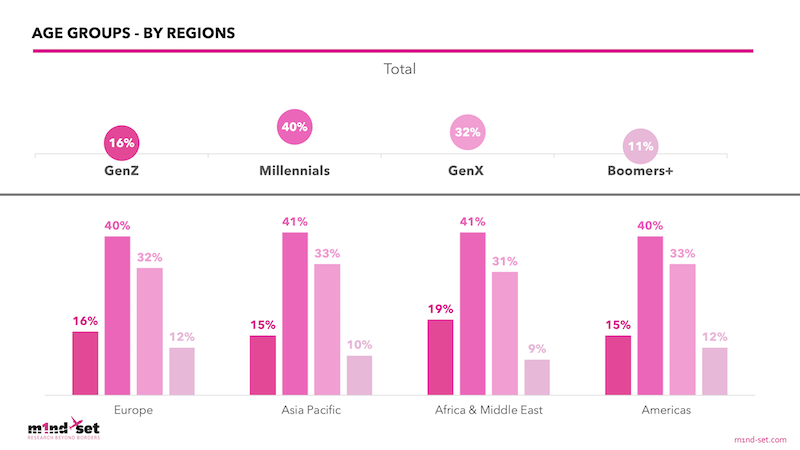
Leading travel retail research agency m1nd-set has identified Millennials as the industry’s growth engine. Comprising approximately 40% of the traveler base across all regions, Millennials lead all age groups, with a global average spend of US$142 and a robust conversion rate of 67%.
The research also highlights a contrast in shopper behavior between a tendency for discovery, and purchase planning for specific products in advance. The younger generations demonstrate a strong appetite for discovery, frequently purchasing items they have never bought before. According to m1nd-set, 67% of Gen Z and 65% of Millennials made first-time purchases in duty free shops, although regional divergences exist.
Boomers are the most specific planners globally, with 31% choosing which brand and product they intend to buy before entering a store. Gen Z and Gen X are the most impulsive, with 32% of each group making spontaneous purchases in duty free shops. By category, Boomers demonstrate a greater preference for Alcohol (28%) and Tobacco (23%) purchases, while Gen Z shoppers demonstrate the strongest interest in Food (42%) and Millennials lead in Beauty (56%), reports m1nd-set.
Peter Mohn, CEO and Owner of m1nd-set underlined the importance of the research findings.
“Understanding generational differences in shopper behavior is critical for travel retail stakeholders to optimize engagement with an increasingly diverse multi-generational traveling public,” Mohn said. “By moving beyond one-size-fits-all strategies and effectively engaging a diverse, global customer base, retailers can remove purchase barriers and optimize revenues across different regional markets.”
Mohn cautions that global trends do not always reflect what happens in individual regions.
“While Millennials are the highest spenders worldwide, older travelers spend more than younger generations in Asia Pacific, underlining the need to adapt retail marketing strategies to regional dynamics,” Mohn added. “In Asia Pacific for example, Gen X shoppers lead with US$154 average spend, followed by Boomers ($138) who outspend both Gen Z ($135) and Millennials ($132). In the Africa and Middle East region on the other hand, we see the highest average spend for Gen Z shoppers at $164.”
Human interaction is a vital conversion tool, particularly for younger shoppers. Millennials (56%) and Gen Z (54%) demonstrate the highest staff interaction rates, with 76% of both age-groups stating that the interaction directly influenced their final purchase decision.
The research also identifies the hurdles that stakeholders need to navigate to capture further growth. Globally, convenience and time remain the primary barriers to visiting a store (40%), (Boomers 45%). Once inside the stores, however, product assortment is the main barrier to buying (49%), followed by price and promotions (45%). Millennials are the most sensitive to variety (50%), while Gen Z shoppers are the most likely to walk away due to higher prices or a lack of promotions, the research reveals.
“As generational profiles continue to evolve across regional markets, understanding local generational differences and responding to age-specific shopper expectations is becoming as important as nationality or category-specific marketing,” says Mohn.
“Given their higher conversion rates, a pronounced appetite for discovery, and a stronger reliance on personal staff interaction, Millennial and Gen Z travelers emerge as the primary engine for industry growth. Their more exploratory approach and reliance on online price comparison will require travel retail stakeholders to reassess how they engage with their most active shoppers.”
“Stakeholders need to move beyond broad demographics, taking into consideration these age-specific nuances, to deliver tailored value propositions that resonate with the unique behaviors of every traveler,” Mohn concluded.
Companies interested in acquiring the research can contact m1nd-set at info@m1nd-set.com.