
m1nd-set has published the second instalment of its ten-year retrospective analysis of the global duty free shopper.
Following the release of Part 1 of the land-mark study, which examined footfall, conversion, purchase purpose and the growing appeal of exclusives, this new research focuses on what happens once passengers reach the shop floor, reports the research agency. Based on a decade of shopper insights from m1nd-set’s Business Intelligence Service (BIS) between 2016 and the first half of 2026, it tracks the shifting weight of value, in-store experience, brand, exclusives, promotions, price comparison, digital marketing and the influence of sales staff.
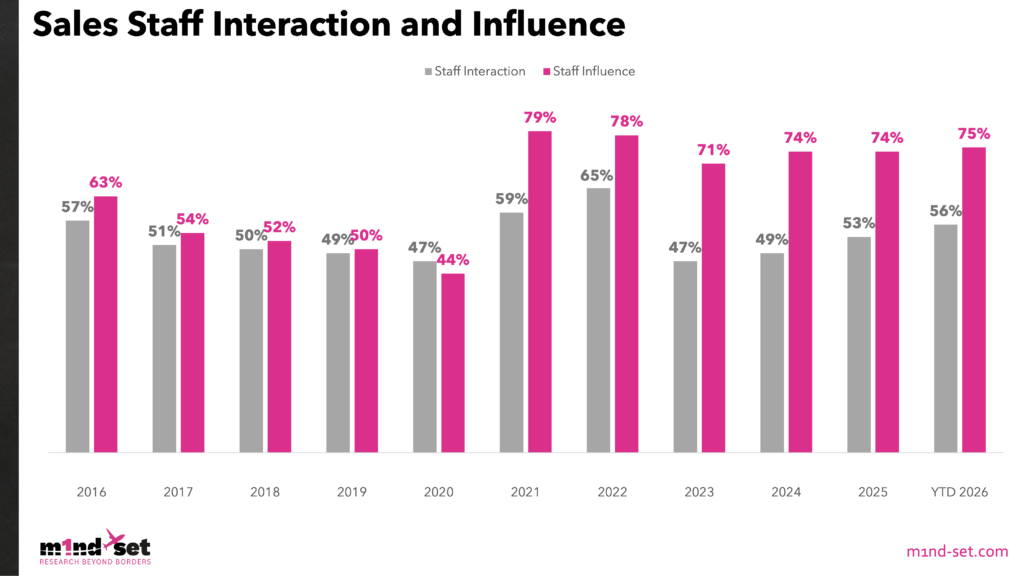
The research reveals that the relative importance of pure value has declined markedly. In 2016, 74% of global travel retail shoppers identified value as a purchase driver; this fell to 50% in H1 2026, the research reveals. In-store experience, a purchase driver for 62% of global shoppers in 2016, experienced a decline around the global pandemic period, before recovering to 54% in 2026. The availability of premium brands as a purchase driver rose from 22% to 30% over the same period.
Promotional purchasing has also eased, according to m1nd-set. Initially recorded at 54% in 2016, promotional purchasing increased to 68% in 2022 during the post-pandemic recovery. However, the share of shoppers buying on promotion has since declined to 47% in the first half of 2026. Price comparison on the other hand has increased over the last ten years, climbing from 60% in 2016 to 65% in 2026 after sharp swings during and after the pandemic years.
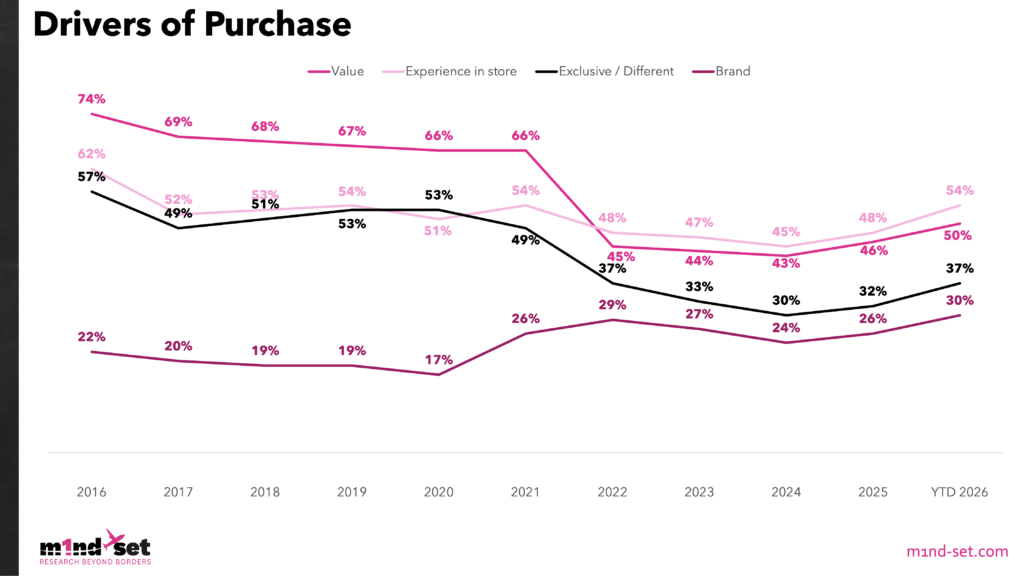
Awareness of digital and in-terminal marketing touchpoints followed a turbulent path, falling to 14% in 2020 before rising sharply and then settling at 31% in the first half of 2026. Staff interaction rates remain close to their 2016 level of 57%, stabilizing at 56% in H1 2026. The influence of those engagements, however, has strengthened. Three-quarters of shoppers who interacted with sales staff in 2026 said the staff had positively impacted their final purchase decision, up from 63% a decade earlier, the research reveals.
Commenting on the findings, Dr Peter Mohn, CEO & Owner at m1nd-set, said: “Ten years ago value was by far the main reason people bought in duty free. Today it still matters, but it is no longer as important. Shoppers are influenced by a much wider set of factors, such as the quality of the store environment, the strength of the brands on offer, the ability to check prices, and the advice of sales staff. Stakeholders must no longer treat value as the only lever.”
“The gaps that characterized shopper behavior in 2016 have closed considerably,” Mohn continued. “Whichever world region a traveler is from, their expectations on the shop floor are now much more consistent. This means that marketing, merchandising and staff training can no longer assume large regional differences in the weight given to value, experience or brand. The same core elements matter across the board, even if local nuances remain.”
Regional differences narrow
Regional differences in both interaction and influence have likewise narrowed, leaving only modest variations between markets. Staff interaction rates were consistently higher among travelers from Asia Pacific and the Middle East & Africa in the years leading up to the pandemic. Shoppers from the Americas generally interacted less often, apart from a brief peak during the recovery period. European travelers tended to engage the least frequently. By the first half of 2026 these regional differences had narrowed considerably, with interaction rates converging in the low-mid-fifties across all regions. m1nd-set says staff influence over the past decade has been quite consistent across all world regions apart from minor variations. Regional differences have since narrowed however and the impact of staff interactions has now converged to around 75% across all regions.
“A helpful, well-informed assistant still makes a measurable difference,” says Mohn. “Even as price comparison becomes commonplace and digital messaging reaches more travelers, engagement with sales staff is more effective than it was a decade ago. Investing in staff knowledge and relevance is not a soft option; the insights show that sales teams directly impact conversion.”
According to m1nd-set, the insights imply that global shoppers are influenced by several factors rather than one or two dominant ones, and that their behavior is more uniform across regions than at any point in the past ten years.
“The challenge for the industry” Mohn added, “is to ensure that shoppers understand the value of the duty free offer, they discover an in-store experience that is truly engaging, and they find brands they recognize and trust. It’s equally important that digital touch points are visible to travelers before and during their journey, and that staff are able to guide shoppers in their purchase decision. Stakeholders also need to reassess how they segment their consumer groups.” Mohn continued. “Shopper behavior previously differed quite broadly across world regions but is now much more aligned in several key areas. Marketing, store layout and training programs need to reflect this reality while still allowing for differences between individual shoppers and markets.”